
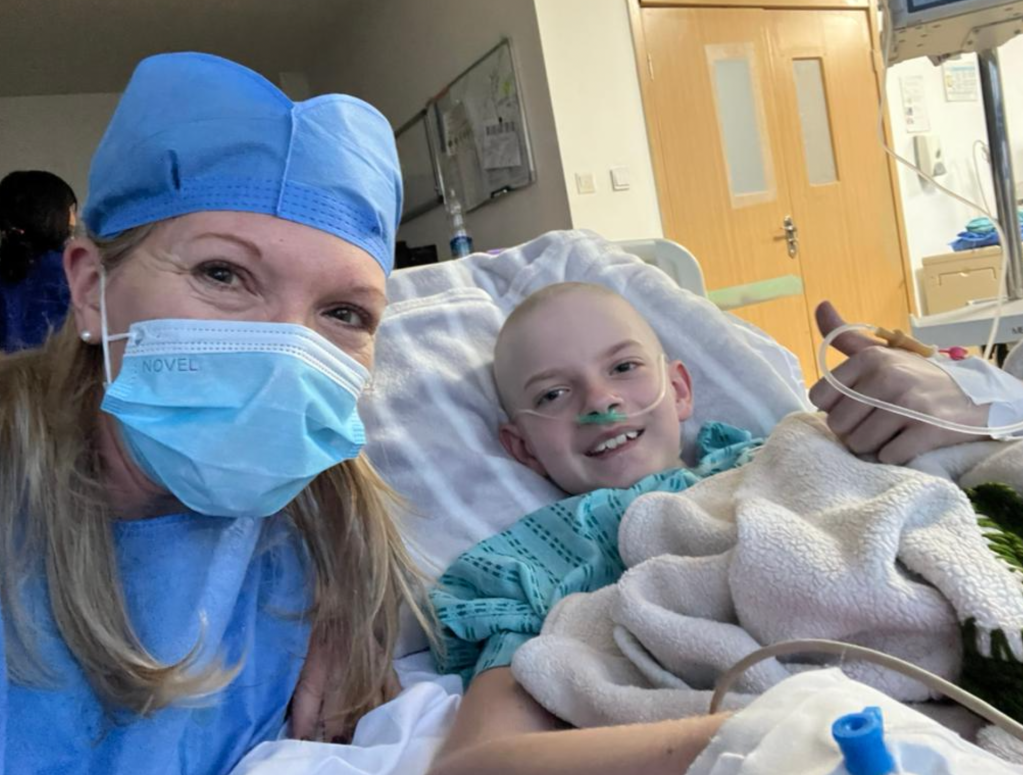
I thought I knew the landscape of disability. As a mother to two children with Autism and one with Dyslexia and a PhD student in Special Education, my world has been shaped by ILPs, accommodations, postsecondary transition research, and advocating for a world that doesn’t always think in a neurodiverse way. I’m familiar with the long, winding road of neurological differences.
But I’ve just been reminded of a brutal, humbling lesson: disability can knock on your door at any minute, without warning.
It started only 20 days ago. Samuel’s symptoms were vague at first: Headaches. Dizziness. Nausea. Then came the moment that split my life into a “before” and an “after”: I watched my youngest son seize in front of my eyes for the very first time. Then again. And again.
On that first day, November 12th, the terror was horrible. He had at least ten seizures in an hour. The hospital medicine slowed them down but didn’t stop them. When the doctors said they needed to move him to the ICU, our world froze. We didn’t have any answers yet. All we heard was “ICU.”
For those few hours, we truly did not know if what we were dealing with. We didn’t know if he had a brain tumor, or something worse.
What followed was a whirlwind. Hospitals, international travel for care, and a crash course in a new kind of advocacy. I quickly booked flights and struggled to find the place where he could get a wheelchair, so I scrambled to get him a wheelchair at the airport, only to find ourselves basically carrying our exhausted son through the vast Bangkok airport when no chair was waiting when we landed. We moved from MRI machines to EEGs, each test a silent prayer.
The relief when his MRI came back normal was a tidal wave. Thank God. The diagnosis was frontal lobe epilepsy. Through it all, his spirit was a beacon of light. He faced endless needles with a bravery that shattered me. He was positive, even when it was clearly wearing on him.
But then, a few days ago, in the back of a Grab car on the way to another blood draw, the dam broke. He quietly dissolved into tears. “What’s wrong, sweetie?” I asked.
Through his sobs, he whispered the words no parent should ever hear: “I don’t want to die.”
In that moment, thank God, I had the knowledge of his clear MRI. I could hold his face and tell him, definitively, “You are going to be okay. You are going to live a normal life. We just have to make sure you take your medicine.” The reassurance was a lifeline I could finally offer—a stark contrast to the powerlessness of those first hours.
And now, we are learning our new normal. We’re dealing with new accommodations: only showers, no baths without supervision (for fear of drowning during a seizure). And we’ve learned that he has now been unequivocally disqualified from ever joining the US military. Not that this was a direct goal, but it’s a limitation that has now been imposed, a door closed before he was even old enough to know it was there.
This is the point where it all crashes together.
When we talk about inclusion, when we chant that “disability can happen to anyone,” it can sound like an abstract concept. I’m here to tell you, from the front lines of a life already dedicated to difference, that it is not abstract. It is a switch that flips in a single second.
One minute, you’re fine. The next, you are carrying your child through an airport because the accessibility system failed. One minute, you’re managing academic modifications. The next, you are holding your son as he confronts his own mortality.
This is why we must push for inclusion. This is why we must make our world more accessible. Not just for the disabilities we anticipate, but for the ones that arrive unannounced. You truly do not know what tomorrow holds.
We are so deeply grateful. Samuel is going to be okay. We have amazing doctors, effective medication, and are pursuing answers. But this experience has opened a whole new door of understanding for me. Our journey with neurological diversity has now expanded to include a biological disability.
My advocacy, my voice, and my understanding of what it means to build a truly inclusive world have just been profoundly, and permanently, changed.
For other parents navigating this scary new path, know you are not alone. Hold onto the moments of bravery, and never stop advocating for the care and accessibility your child deserves.
 Autismdreamx3